30 November 2018

The Story of the Sun-Child

                        The Story of the Sun-Child                        
(A Legend from Tonga)

Once upon a time, there was a great chief in Tonga who had a beautiful young daughter. She was so fair that her father hid her from the eyes of men so that no one could see her, for he had not found a man whom he thought worthy to be her husband.

The chief built a high, thick fence down on the shore. Behind this, she was allowed to sit and bathe in the sea every day, until she grew up to be so beautiful that there was no maiden to compare with her.

Now it happened one day that the Sun looked down from his home in the sky and saw her as she rested on the white sand. Immediately he fell in love with her, and after a time a child was born to her, and she called him the Sun-Child.


The child grew and developed into a handsome lad. He was proud and strong and used to beat the other children as if he were the son of a great chief. One day while all the village lads were playing together on the green he was angered by something. And he picked up a stick and beat them with it until their bodies were sore and his arm ached.

Then they rose up and taunted him, saying, “Who are you, and why should you beat us? We know who are our fathers, but you-you have no father!" At this, the Sun-Child was filled with a great rage, and he would have tried to kill them. But he seemed to be rooted to the ground, and his voice became hoarse and his eyes brimmed with tears.

For a moment he stood and glared at them. Then with a loud cry he ran quickly to his own house. His mother was inside, and he seized her by the arm, crying out. “Tell me, mother, who is my father? What do the village boys mean?" And he burst into tears.

“Hush, my son," said his mother, “take no notice of them and do not let them trouble you, for you are the son of a greater chief than their fathers."

“But who is my father?" asked the lad again.

His mother laughed scornfully and said. “Who are those village boys, and why do they despise my son? They are the children of men, but the Sun is your father."

So the Sun-Child wiped away his tears and was happy. “I will not talk to those children of men any longer. I will not even live with them, for I scorn them. I shall go and find my father," he said defiantly.

He called “Farewell” to his mother and set off without ever a backward glance, and she gazed after him until he was hidden by the bushes and the trees. Through the forest, he strode until he came to the beach where his own canoe lay, and at high tide, he launched it and sailed away to find his father.

Now it was the early dawn when he hoisted his sail, and he steered toward the east, where the Sun was rising, but as time passed the Sun rose higher and higher, and though the boy shouted loudly his father did not hear him.

Then he tacked and sailed over to the west as the Sun began to dip toward the horizon, but although he made a fair speed he could not reach his father before he disappeared beneath the waves. The boy was left alone in the wide sea to ponder his next plan.

“My father climbs up out of the water in the east,” he said to himself, “so it is there I must go to catch him.” He tacked again and sailed eastward all night, and as morning dawned and the Sun rose close to him he shouted aloud. “Look, father, I am here!”

“Who are you?” asked the Sun as it climbed steadily higher.

“Surely you know me! I am your son." cried the lad, “and I have left my mother behind in Tonga. Stay, oh, stay awhile and talk to me."

“I may not stay,” said the Sun, “for the people of earth have already seen me. You should have been a little earlier. Now I must go on my way." He bade his son goodbye and rose even higher in the sky.

“Father, stay,” cried the lad. “Could you not hide your face behind a cloud and then slip down and talk to me.

“Truly you are wise, my child,” said the Sun, laughing. “For a mere lad you have much wisdom." Then he called for a cloud, and when he had disappeared behind it he slipped down again into the sea. There he met his son and greeted him, and he asked after his mother, and they talked of many things.

“I can stay no longer," he said after a little while, “but listen to me: if you remain here until the darkness comes over the water, you will see my sister the Moon. She is your aunt, so call out to her when she begins to rise from the sea. She has two very precious things: ask her to give you one of them. You must ask for the one called Melaia, and she will give it to you. The other is called Monuia, and you may not have that. Now remember what I have told you and all will be well, but beware of evil if you disobey me."

Then the Sun leaped above the cloud again, and the world men thought how slowly he was climbing into the sky that day. Meanwhile, the Sun-Child furled his sail and lay down on the folds in his canoe and slept until evening. When he awoke he hoisted his sail and waited for the first pale streaks of moonlight. Then he hastened with all speed to his aunt, and he was close upon her before she had risen above the water.

“Luff, luff, child of the earth." she cried out, “or you will pierce my face with the stem of your canoe."

So the Sun-Child altered his steering oar and kept away a point, but he almost touched the moon's face as he passed. Then luffing into the wind suddenly, he shot up alongside her and caught hold of her firmly.

“I am no child of the earth,” he said. “I am the Sun's child, and he is your brother, so you are my aunt."

“Oh, are you indeed !" said the Moon. “That is a great surprise, but you are hurting me, nephew, so I beg you to loosen your hold."

“No, no," said the boy, “if I let you go you will leave me, and then you will not give me the present that my father told me to ask for."

“Truly I will not leave you, nephew,” replied his aunt. “I am indeed glad to see you, only let me go.” So the lad loosened his hold, and then the Moon asked what it was that the Sun had bade him ask for.

Now all this time the Sun-Child, who was a disobedient and high-spirited youth, had made up his mind not to follow his father’s instructions. So he said. “My father told me to ask for Monuia."

“For Monuia ?” cried his aunt with surprise “Perhaps, nephew, you have forgotten your father’s words? Did he not tell you to ask for Melaia

“No, he did not,” the lad replied indignantly. “He said I might have Monuia, and that you were to keep Melaia."

This is strange indeed, thought the Moon. Surely my brother cannot hate the boy and wish to harm him, and yet I must obey his commands. Then aloud she said to her nephew, “Very well, you shall have Monuia. It is only a little thing and wrapped in a piece of cloth. See, I will put it inside yet another wrapping and I will bind it around and around many times to make it firm so that it cannot come open by itself. Take it now, and I implore you to remember my words. Do not undo the wrapping and take out the present while you are still at sea. Now away with you, and set your sail for Tonga, and I warn you once more not to look at Monuia until you have landed or a terrible evil will befall you."

She bade him good-bye and climbed upward in the sky, giving her pale light to many. The mariners at sea welcomed her, and the children in the villages came out of their houses and started to dance on the grass.

Then the Sun-Child steered for Tonga and sailed for two nights and a day until on the morning of the second day he saw land. Then he could wait no longer, for he was an impatient lad and self-willed. So he took up the parcel that his aunt, the Moon, had given to him and untied the string. He unrolled each fold of cloth until at last, he held Monuia in his hand.

It was a most beautiful pearl shell of an unusual red colour. Such a one had never been seen before, and it shone in his hand as he gazed at it. He thought how fine it would look like an ornament hanging around his neck, and how all the boys would envy him.

At that moment he heard a mighty noise like a rushing and a splashing over the water. He looked up and saw from every side a great throng of fishes swimming toward him. There were fish of every kind, and great whales and sharks, porpoises and dolphins and turtles, and they leaped upon him in their eagerness to reach the shell. So great was their weight that his little canoe sank beneath the waves, and the Sun-Child was seen no more.

Source:
Tales from the South Pacific Islands
Anne Gittins
1977
Pages: 60-65

24 November 2018

Two Lovers and How the Turtle Cycle was Discovered

Two Lovers and How the Turtle Cycle was Discovered
(A Legend from Palau)

A young man from Peleliu fell in love with a maiden from Ngerkebesang. She also loved him. But they lived on islands far apart, and their families did not approve of their love for each other.

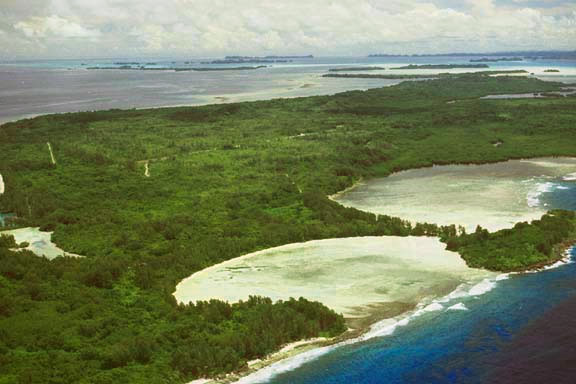
Aerial view of Peleliu (Wikimedia Commons)

The two young people agreed that one night each month during the safe darkness of a new moon they would sail their outriggers to the Ngemelis, a tiny island located midway between their homes.

In the darkness of the moonless night, they talked and touched until the first blush of dawn. Quickly the young woman gathered her mat and her paddle to sail back home, but no matter how carefully she searched, she could not find her grass skirt. She had left it on the sandy beach, but all she could find was a few strands next to the footprint of a turtle. Finally, she made a new skirt from coconut fronds and hurried to her canoe. As she waved farewell to her lover he cried out to her. “I cannot wait a whole month; let us meet again soon.”

“When the moon is full.”

“Yes,” he shouted back. “I shall return to this very place when the moon is shining round and silver like a tuna’s stomach.”

On the appointed day, both lovers impatiently waited for the night so they could secretly begin their long paddle before the rising of the moon. First, the young man arrived and then the young woman. No sooner had she stepped onto the beach than her lover held her in his arms. But their embrace was suddenly ended as they both heard the sound of something else coming onto shore. They laughed with relief as they realized the large, dark figure was a turtle crawling toward them. But what they saw next surprised them even more. On the turtle’s front fin was entangled the maiden’s grass skirt, the very same skirt she lost the night of the new moon. As the two young people quietly watched, the mother turtle scraped a deep hole and laid egg after egg, each one round and white like a full moon. Nearly fifty eggs filled the sandy nest before the mother turtle covered them with sand, rested, and then slowly crawled back through the bubbling surf into the dark sea.

Thus the people of Palau learned during which season of the year to watch for turtles to return to the very beaches where they once hatched. When the moon is new, a turtle lays the first half of her eggs and then returns two weeks later when the moon is full to lay the second half. Up to a hundred eggs are carefully buried in the sand, where they stay warm and hidden. During the next full moon, the baby turtles hatch out. They pull with their tiny fins and crawl to the sea, following the “moon path,” the ribbon of light made by the full moon shining on the sea.

Source:
Micronesian Legends
Nancy Bo Flood, Beret E. Strong, William Flood
2002
Pages: 48-49

18 November 2018

How Ina Tattooed the Fish

How Ina Tattooed the Fish
(A Tale from the Cook Islands)

Long ago there lived a fair maiden called Ina. Her parents were wealthy, for they possessed many beautiful shells which they wore as jewellery and a fine headdress made from scarlet and black feathers. These ornaments were put out to air in the sunshine regularly, and they were guarded with care.

One day the parents left their home, bidding Ina mind the treasures. But an evil spirit named Ngana, who was lurking behind the bushes, overheard their conversation. Waiting until the father and mother were out of sight, he came to Ina and begged to see the ornaments, and then he asked to try them on. With soft words and crafty ways, he adorned himself in all the finery, last of all adding the feathered headdress. Then he began to dance all around the house, for Ina had taken him indoors to prevent him from escaping. However, he spied a hole in the roof, and flying up through it he disappeared forever.

Not long afterward the parents returned, and when they discovered the loss of their treasures they were very angry with Ina. They beat her with sticks and branches of trees until the weeping girl ran down to the beach to escape from their rage. Her two brothers followed her, but she bade them farewell and declared that she would try to find Tinirau, the lord of all the fishes.

Now Tinirau lived on the Sacred Isle, which lay toward the setting sun. Ina gazed wistfully over the ocean, wondering how she could reach his island. Looking about, she noticed a small fish. the Avini, swimming by her feet.

“Ah, little Avini.” she cried to him, “are you an ocean-loving fish? Bear me on your back to Tinirau, and he shall be my royal husband.”

The little fish consented to take her, and Ina sat herself on its narrow back. But it had not gone far before it found her too heavy, so it turned over and tipped Ina into shallow water. Angry at this wetting, she struck the Avini again and again, and the stripes on the side of the little fish are still there to this day.

Returning to the shore, she looked about for a larger fish, and very soon a Paoro came near her, and he said he would be pleased to take her on this romantic voyage. Again Ina proved too heavy. The Paoro dropped her off his back and swam away, but not before Ina had struck him angrily and left blue marks upon him. He and his descendants still keep the marks, and like the Avini’s stripes, they have been called “Ina's tattooing.”

Then a white fish appeared, but even this one was unable to carry Ina, and she turned him completely black to mark her disgust at the third failure.

She now tried another fish, a sole, and together they reached the edge of the breakers before she was tipped off the fish’s back. This time, in her rage, Ina stamped on the head of the unfortunate sole with such energy that the eye on the underside came through to the upper side. Ever since that day, the sole has had to swim flatwise because one side of its face has no eye!

Then, far out in the deep water, a shark came in sight, and Ina called to it and begged it to take her to the Sacred Isle. When the great fish swam close to her, she mounted its broad back, taking with her two coconuts to eat on the journey.


When they were halfway across the sea she felt thirsty, so the shark raised up its dorsal fin, and on this Ina pierced the eye of one of her nuts and drank the milk. After a while, she again felt thirsty and asked the shark for help. This time the shark lifted its head, and Ina cracked the hard shell on its forehead. Smarting from the blow, the shark dived into the depths of the ocean and left her floating in the sea, and ever since then, he has carried a bump on his forehead.

The king of all sharks then came to rescue Ina, and after many more adventures she reached the Sacred Isle and went ashore. Here she was surprised to find salt-water ponds full of every sort of fish, and slowly she made her way to Tinirau's dwelling. Finding no one in the house, she beat gently on a drum that stood nearby. The noise of its booming reached Tinirau, who was over on another island, and he returned with haste to his home.

Ina saw him nearing, but suddenly being overcome with shyness, she hid behind a curtain. Tinirau could find no one and was about to set off once more when Ina beat again on the drum. This time Tinirau found the maiden. Enchanted by her beauty, and hearing of her courageous voyage to find him, he fell in love with Ina and made her his wife.

Ina then lived happily on the Sacred Isle with her husband, the lord of all the fishes: and in the course of time, she bore him two children, a boy and a girl.

Source:
Tales from the South Pacific Islands
Anne Gittins
1977
Pages: 76-78
https://readingwarrior.com/cook-islands-heroes-ina-tinirau/ (Picture)


16 November 2018

The Gift

The Gift
(A Tale from Hawaii)

In the early days very long ago, the people of Hawaii did not have any clothes except what they could make from grass or leaves or feathers. They had not learned to make cloth either to wear or to use on their beds at night. When the stormy season came, or if they lived up in the mountains, they suffered greatly from cold. At night, too, they often had a hard time keeping warm. In the summer, the fierce rays of the sun burned them.

Now at this time on the Island of O-a-hu, there lived a good old man named Ma-hi-ko-ha. One grey day it happened that Ma-hi-ko-ha was climbing the steep mountain trail along the Nu-u-a-nu stream. Because he was old, he climbed very slowly. Every little while he stopped to rest by leaning upon the strong stick that he used as a cane. Often he looked up at the mountain tops, where black clouds were beginning to gather.

“It’s going to storm,” said Ma-hi-ko-ha to himself. “The leaves of the ku-ku-i trees are turning silver, and the wind is starting to blow. I must get home before the storm breaks.”

The wind was cold, and Ma-hi-ko-ha shivered as he hurried on his way. “How sad it is,” he thought, “that we Island people must suffer so from the cold in winter and from the heat of the sun in summer. If only we had something to wear to protect us!”

The rain began to pelt down, and Ma-hi-ko-ha was dripping wet by the time he got home. He crawled through the low, narrow doorway of his thatched hut, and Me-li-a, his daughter, did her best to warm him.

“I’m afraid you’ll get ill, Father,” she said. “Here is a little a-wa to drink, but how I wish I had something to put over you to keep off a chill!”

“That would be good,” said Ma-hi-ko-ha. “And it would be good if all the people had some kind of covering to put on or take off as the weather changed.”

Ma-hi-ko-ha drank the a-wa. Then he sat and thought for a long time. At last, he said, “Me-li-a, I am an old man. I know I shall not live much longer. When I die I do not want to be buried in a mountain cave like the rest of our people. I want to be buried beside the Nu-u-a-nu stream. Will you promise me that?”
“Oh, Father!” Me-li-a wept, “I cannot bear to hear you speak of leaving me.”

“Me-li-a, I shall not really leave you,” said the old man. “If I am buried by the stream, a wonderful tree will grow on my grave. It will be my gift to you and to the Island people.”

“But I would rather have you alive than have a thousand trees!” cried Me-li-a.

“You will have a thousand trees-strange and wonderful trees!” replied her father. “Now listen.”

Then he went on to tell her that when the tree had grown to a good size she must strip the bark from the branches and spread it on a flat rock by the stream.

“After that,” he said, “sprinkle the bark with cool water and pound it with a stone. Only then will you see how wonderful my tree is."

“But it will be as though I were pounding you, Father!” cried Me-li-a.

“You must do as I say, my child,” said Ma-hi-ko-ha. “And remember, each time that you strip a branch, plant another branch by the stream. Will you promise me all this?”

At last, to make him happy, Me-li-a promised. A few days afterwards, Ma-hi-ko-ha became very ill and died. As she had promised, Me-li-a buried him beside the Nu-u-a-nu stream. Then she went sadly home.

After some weeks had gone by, Me-li-a went one morning to visit her father’s grave. To her surprise, she found growing from it a kind of tree that, she had never seen before. She could not help noticing how thick and soft the bark was. Then she remembered the promise she had made to her father.

Quickly she broke off a branch and stripped the bark from it. After she had placed the bark on a flat rock by the stream, she dipped her fingers into the cool, running water and shook the drops onto the bark. Then she began to pound the bark with a stone.

As the water soaked in, it softened the bark. When Me-li-a pounded it, the bark became thinner and thinner and spread out wider and wider. At last, she stopped working to look at it.

“Oh, my Father,” she cried when she saw how smooth and soft and thin the bark was, “you have given us a most wonderful gift-the gift of cloth! From the bark of your tree we can make clothes to wear and coverings for our beds!”

Then, remembering what else her father had said, Me-li-a took another piece of branch from the tree and planted it on the bank of the stream. She did this each time that she stripped bark from a new branch. The pieces all took root and before long other trees of the same sort sprang up. Soon they were growing all over the mountainside.

Me-li-a taught the others in her village how to prepare the bark. It was not long before the sound of pounding could be heard all over the Island, in the sheltered valleys as well as along the seashore. The people called this new stuff that they were making by the name tapa.

At first, all the tapa was grey, but, they soon learned to dye it with vegetable colouring. Then they made pink, yellow, and brown tapa cloth and covered it, with beautiful designs and figures.

Making tapa (Fiji, 1911)

In this way, Ma-hi-ko-ha’s tree brought great comfort and great beauty into the lives of the people. They were so thankful for this wonderful gift that they made him the special god of the tapa-makers. Even today you may be sure that Ma-hi-ko-ha is remembered wherever tapa is being made.

Source:
Hawaiian tales
Helen Lamar Berkey
1968
Pages: 19-23
http://www.janeresture.com/oceania_postcards8/ (Postcard)

11 November 2018

K’ow and Buneney

K’ow and Buneney
(A Tale from Yap)

In a time long ago, the people of Yap could change their form. They could become an animal, or even a plant if they wished.

Yap Island

One vain young woman decided to become a Buneney, an elegant white crane.

The Buneney was beautiful, with glistening white feathers and a graceful long neck. She used her long neck often, especially to look at her reflection in the still pools of water near the lagoon.

“My, I am truly beautiful!” she would announce. I deserve to marry a handsome man.”

White Crane

Day after day, Buneney spent her mornings looking at herself in her water mirror. She did not notice the shy grey crane, K’ow, who watched her from beneath the coconut palms.

Many young men of the village wished to marry the beautiful Buneney. She refused them all. “You men of this village are too plain for me. I must marry an especially elegant man.”

One by one the men went away, muttering about the proud Buneney. But K'ow continued to watch. Every day he brought her gifts of fish and fresh food. She never once said. “Thank you." In fact, she did not even seem to notice K’ow.

One day Molob, the great black frigate bird, came to this village on Yap. He had heard of the beautiful Buneney. He wished to see her for himself. Now Molob was a large and handsome bird. His kind is rarely seen near the land. He prefers to soar far above the ocean, almost in the clouds themselves.

Buneney was beside herself. Molob was so handsome! Molob was so big. And Molob had asked Buneney to be his wife.

“Oh, yes!” Buneney replied. “I will soar with you. We can look down on these lowly villagers together.”

Buneney was a land crane so she could not fly high. Molob was very large and very strong. He placed Buneney on his broad back. Together they soared high into the sky.

Far below, little K’ow wiped the tears from his eyes. He went back to gathering fish and food for his supper. He missed the white crane. He loved her and did not even mind that she never spoke to him. Now she was gone.

Molob and Buneney flew higher than Buneney had ever imagined. The land below looked like a toy. She could hardly see the people at all. “This is the life, Molob. Yes, this is the life!"

After a time, Buneney was beginning to feel a little tired. "Molob," she asked, “Where is our home to be?"

“This is our home," replied Molob. “I live here in the sky. Do you like your new home?"

“Well,” answered Buneney, “I think so. But I do miss my nest on the ground a little bit.”

Later, as they flew higher and higher, Buneney found herself feeling a bit hungry. On the ground, when she felt hungry she just opened her mouth. That nice grey crane, K'ow, was always right there to pop in a fresh fish. Maybe Melob would be nice too?
“Molob, my husband."

“Yes, Buneney?"

“What is there to eat, in this magnificent home in the sky?"

“Eat? Why just open your mouth, my wife, and fly to the east."

Buneney opened her mouth and flew toward the east. Nothing happened.

“I am still hungry," she said.

“Open your mouth and fly toward the west this time.”

She did, but still, nothing happened. She was getting very hungry.

“Husband, I am very hungry, and I cannot find anything to eat.”

“But Buneney,” Molob answered. “I eat only the air. Isn't it delicious?”

But Molob," Bnneney wailed, “I eat fish and taro. I cannot eat your air.

I am sorry, Buneney. These foods are strange to me. I do not have any of them here.

“Then please," Buneney begged, “take me back to the earth before I am too weak and die.”

Molob the frigate bird took Buneney back to the earth. He put her down on a beach not far from her home. Then he launched himself back into the air and was gone.

Buneney was so week she could hardly move. Nearby she saw a small fish trap. There were some fish caught in the trap. She did not see K‘ow, the owner of the trap, sitting nearby on a rock. She took a fish.

“Who is stealing my fish?" K'ow demanded, pretending not to see Buneney.

“Oh please," begged Buneney, “I am starving. Please let me have a little food."

“All right,” answered K’ow. “Since you are hungry I will give you coconut to drink and fish to eat.” He also gave her taro to eat and betel nut to chew.

Buneney ate. She looked gratefully at the grey crane. How kind he was. How strong he looked as he gathered the fish and brought her taro.

“K'ow, I am sorry I was so mean to you. I see you are a good provider. You have a caring heart. I would like to marry you if you will still have me."

K'ow was overjoyed. “Remember,” he counselled, “The wind does not always blow from the same direction.” Which is to say that one should think twice before leaping. Buneney knew this now. She had leaped far into the air and had almost died. Now she would stay on the ground.

K'ow and Buneney lived happily together for many years. They had many children. And Buneney always had plenty to eat.

Source:
Pacific Island Legends: Tales from Micronesia, Melanesia, Polynesia and Australia.
Nancy Bo Flood, Beret E. Strong, William Flood
1991
Pages: 56-58